

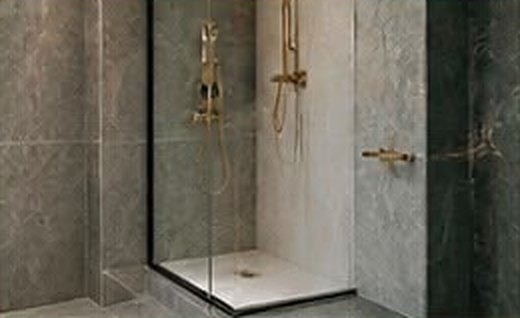
Bathroom tanking is a waterproof layer applied to walls and floors before they're tiled. It's needed because tiles and grout aren't waterproof: grout is porous, and over time water works through it into whatever is behind. Wherever water hits the walls or floor directly -- every shower, a shower over a bath, and the whole of a wet room -- bathroom tanking should go on before a single tile does. We tank these areas as standard, not as an extra.
(This is about bathrooms. "Tanking" is also the name for waterproofing basements and cellars, which is a different job altogether.)
What is bathroom tanking?
Tanking sits between the wall or floor and the tile adhesive. It's usually a liquid membrane rolled on in two coats, a flexible sheet bonded to the wall, or a board system with a waterproof core, always with reinforcing tape or fleece in the corners and joints.
The tiles themselves shed water well. The problem is the grout lines and the joints around trays and baths. Every time the shower runs, a little water soaks into the grout. In a lightly used room it dries out between uses; in a busy family shower it often doesn't. Without a membrane behind it, that moisture reaches the wall, and if the wall is plasterboard it softens, the adhesive lets go and tiles start to sound hollow or come loose. By the time you notice, the damage behind is usually well under way.
Where you need to tank: a room-by-room guide
| Area | Tank it? | Why |
|---|---|---|
| Wet room | Yes -- the whole floor and the walls in the showering area | The floor is the shower tray. Any gap in the membrane leaks straight into the floor below. See our wet room page and wet rooms upstairs. |
| Walk-in or enclosed shower | Yes -- all walls inside the enclosure, and onto the tray upstand | Direct, daily soaking, often on plasterboard. |
| Shower over a bath | Yes -- the walls around the bath to above the shower head | Forums argue about this one. A shower is a shower: the walls get just as wet, and the bath-to-wall joint is a classic leak point. |
| Bath with no shower | Recommended along the bath edge | Splashes and a joint that flexes as the bath fills. |
| Basin splashback | Not usually | Occasional splashes; good grout and silicone are enough. |
| Floor outside wet areas | Depends | Worth considering on timber floors upstairs, and always where a wet room or walk-in shower has no tray. |
Upstairs bathrooms deserve extra care. A failure there doesn't just damage the bathroom -- it comes through the ceiling below.
What's behind your tiles matters
Plasterboard and moisture-resistant board
Standard plasterboard has a paper face and a gypsum core, both of which are damaged by water. Moisture-resistant board (usually green) copes better with steam, but it isn't waterproof. Either needs tanking in a shower.
Cement and foam backer boards
Cement-based boards aren't harmed by water, which is why some tilers argue they don't need tanking. But water-resistant isn't the same as waterproof -- water can still pass through to the studs and the joints between boards. Foam boards with a waterproof coating are designed as a complete system, provided the joints and fixings are sealed with the manufacturer's tape and sealant. That second part is where shortcuts happen.
Old plaster and masonry walls
Common in period Surrey homes. Gypsum plaster is weakened by water just like plasterboard, and older lime plasters and solid walls bring their own issues. We assess these walls during the strip-out and either tank them or board over them first.
Weight limits for heavy tiles
The wall has to carry the tiles as well as keep them dry. Industry guidance based on BS 5385 puts the maximum weight of tiles, adhesive and grout at 32kg per m² on unskimmed 12.5mm plasterboard and 20kg per m² on gypsum plaster. Large-format porcelain and natural stone can get close to those limits (see porcelain vs ceramic vs stone). Board manufacturers sometimes allow more, but if you've chosen heavy tiles, the wall build-up needs planning before the tanking goes on.
Is tanking a legal requirement?
No. The Building Regulations don't require it. What does exist is BS 5385-1, the British Standard code of practice for wall tiling. Its 2018 revision recommends tanking in wet areas such as showers, wet rooms and steam rooms, including in homes.
A code of practice isn't law, but it is the benchmark a tiling job is judged against if something goes wrong. Many adhesive and tanking manufacturers also only stand behind their products when they're used as a complete system. If a quote leaves tanking out of a shower, ask why.
Tanking methods compared
| Method | How it works | Best for | Watch for |
|---|---|---|---|
| Liquid tanking | Primer, then two coats rolled or brushed on, with tape in corners and joints | Most walls; awkward shapes, niches and pipework | Coat thickness and drying time between coats |
| Sheet membrane | Flexible sheet bonded to the wall or floor with adhesive, joints overlapped | Floors, wet rooms, walls that may move slightly | Overlaps and corners take care; slower around detail |
| Waterproof board system | Boards with a waterproof core or coating, joints and fixings sealed with system tape | Stud walls, new shower enclosures, boxing-in | Only waterproof if every joint and fixing is sealed |
None of these is "the best" in every room. A good installer chooses by wall type and layout, and often mixes them -- boards on a new stud wall, liquid tanking on the existing walls, a sheet or fleece membrane on the floor.
The details that make or break it
Membranes rarely fail across a flat wall. They fail at the details:
- Corners, which need reinforcing tape or a pre-formed corner, not just paint.
- The tray or bath joint, where the membrane has to lap onto the tray upstand or bath edge. This is the single most common leak point.
- Pipe holes for the valve and shower head, which need proper seals or collars.
- Niches and shelves, which have more corners in a small space than the rest of the shower put together.
How tanking fits into a bathroom refit
Tanking goes on after the first fix -- once pipes and cables are in -- and after boarding and floor preparation, but before tiling. Liquid membranes need drying time between coats and before tiling, which is one reason a full refit can't be squeezed into a couple of days. Our guide to how long a bathroom refit takes shows where it sits in the schedule. On a full bathroom refurbishment, it's part of the job from the start rather than something added on.
What to look for in a quote
Tanking is often a single line on a quote, or missing altogether. A good quote should tell you:
- That tanking is included, and whether it's priced separately or built into the tiling.
- Which areas are tanked: shower walls, the bath surround, the whole floor?
- How high up the shower walls it goes.
- Which system will be used, and whether it suits your walls and tiles.
- How the tray or bath joint will be detailed.
If the answer to any of these is vague, ask. A tiler who tanks properly will be happy to explain it.
How to tell if an existing bathroom is tanked
Usually, you can't -- the membrane is hidden behind the tiles, which is exactly why missing tanking goes unnoticed for months or years. The clues that something is wrong behind the tiles are tiles that sound hollow when tapped, grout that stays damp or keeps cracking, silicone that blackens quickly however often it's replaced, and any staining on the ceiling below.
Our guide to the signs your shower is leaking covers how to narrow it down. If you're seeing those signs, it's worth getting the area checked before tiles start coming loose. Small, early problems can sometimes be dealt with through tile and grout repair or regrouting and resealing. If water has got behind the tiles, the lasting fix is to strip the area, let it dry and tank it properly before retiling.
Bathroom tanking FAQs
Can I tank a bathroom myself?
Liquid tanking kits are sold for DIY and the rolling-on part is straightforward. The skill is in the preparation and the details: priming, taping corners, sealing pipe holes and lapping onto the tray. Tanking rarely fails in the middle of a wall -- it fails at those junctions.
Does tanking stop mould?
No. Tanking keeps water out of the wall behind the tiles; mould on grout and silicone comes from moisture in the room's air. That's a ventilation problem -- an extractor fan that's missing, undersized or not run for long enough after a shower. A well-tanked bathroom can still grow mould on its surfaces.
Do I still need grout and silicone if the walls are tanked?
Yes. Tanking is the second line of defence, not the first. Grout and silicone still keep most of the water on the surface, and failing silicone at a tray or bath joint puts more water against the membrane than it should ever have to deal with. Keep them in good condition and replace silicone when it starts to fail.
Can you tank over underfloor heating?
Yes, with the right products. Electric heating mats are normally set in a levelling compound and the membrane goes over that, or a combined system is used. Check that the membrane and adhesive are both rated for underfloor heating, and follow the manufacturer's order of layers.
Planning a new bathroom or a retile? Every bathroom we tile is tanked as standard, and we'll show you exactly which areas and which system before work starts. See our bathroom tiling service, or ask for a free quote.